Designed & manufactured in Herefordshire, UK — shipping worldwide Mon–Thu 9–5 | Fri 9–4 | +44 (0)1981 241668

Mobile solar power trailers are changing how businesses access temporary, clean electricity. They combine photovoltaic panels, battery storage, inverters, and a towable frame. This design supports construction sites, emergency services, outdoor events, farms, and remote facilities. Yet performance depends on more than panel size. Battery chemistry, charging speed, weather resistance, transport weight, and service access all deserve careful attention.
For global buyers, this guide examines leading trailer types through practical purchasing criteria. It considers usable output, solar generation, battery capacity, noise levels, deployment time, and maintenance needs. A trailer may look powerful in a brochure but struggle under clouds, dust, or heavy daily loads. Field experience matters here. Operators often value clear controls, stable ground supports, protected cables, and replacement parts as much as peak wattage. Small details can prevent expensive downtime.
No trailer fits every market. Regional transport rules, electrical standards, climate conditions, and local technical support may change the best choice. Buyers should verify certifications, warranty terms, battery safety documentation, and compatibility with their existing equipment. Independent testing is preferable, although test results may not represent every working environment. That limitation deserves honesty. A compact unit may suit a mobile clinic, while a larger system may better support tools and refrigeration. This overview helps readers compare options with confidence, while recognizing that solar output remains variable. Careful sizing, realistic load calculations, and supplier communication can turn a promising trailer into a dependable power asset.
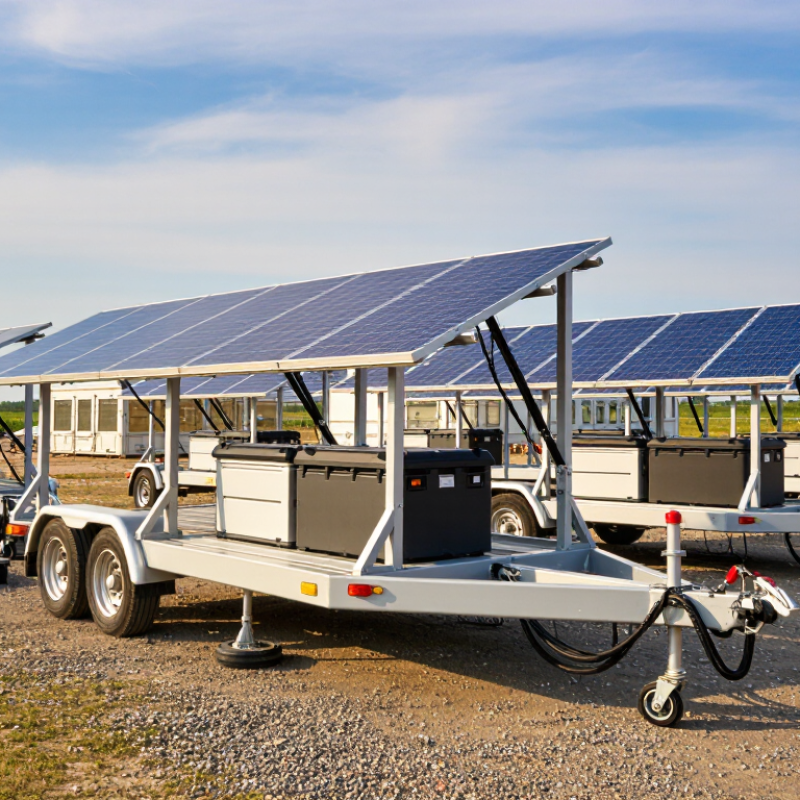
Mobile solar power trailers are towable energy systems built around photovoltaic panels, batteries, power electronics, and a transport frame. They unfold at a worksite, emergency area, farm, or remote construction camp. The panels convert sunlight into direct current. A charge controller regulates that flow, while batteries store electricity for nighttime use. An inverter then supplies alternating current for tools, lighting, pumps, or communications equipment.
Their value reflects a wider energy shift. The International Renewable Energy Agency reported about 1,419 gigawatts of global solar photovoltaic capacity by the end of 2023. However, a trailer cannot match grid reliability in every location. Cloud cover, dust, panel angle, and battery temperature reduce actual output. Field operators should measure daily loads before choosing capacity. A small mistake here creates expensive downtime.
A practical unit may include foldable panels, lithium-based storage, leveling supports, monitoring controls, and protected cable outlets. During deployment, technicians park the trailer on stable ground and face the panels toward the strongest available sunlight. The battery covers short demand peaks, while solar generation restores charge during daylight. Safety depends on correct grounding, overload protection, weather sealing, and routine inspection. IEC 62477-1 provides relevant safety principles for power electronic converter systems. The National Renewable Energy Laboratory also notes that photovoltaic performance declines gradually over time, although real degradation varies by climate and maintenance. That uncertainty deserves attention. The quietest system is not always the most useful one.
| Configuration or Feature | Typical Specification | How It Works | Best-Fit Applications | Key Buying Considerations |
|---|---|---|---|---|
| Compact Mobile Solar Trailer | Approximately 1–3 kWp of solar capacity; 2–10 kWh battery storage; single-axle towable frame | Fold-out or telescopic photovoltaic panels generate DC electricity. A charge controller directs energy to the battery, while an inverter supplies AC power. | Small construction sites, field offices, outdoor events, emergency lighting, and remote monitoring | Low towing weight, compact transport dimensions, simple setup, and sufficient inverter capacity for the intended loads |
| Mid-Size Mobile Solar Trailer | Approximately 3–10 kWp of solar capacity; 10–40 kWh battery storage; commonly fitted with hydraulic or manual panel deployment | Solar modules recharge the battery during daylight. The battery provides stable power when clouds pass or when equipment operates after sunset. | Temporary power for worksites, telecommunications equipment, agriculture, disaster-relief operations, and mobile workshops | Battery chemistry, deployment time, ground stability, inverter output, and compatibility with local electrical standards |
| Large Mobile Solar Trailer | Approximately 10–30 kWp of solar capacity; 40–150 kWh battery storage; reinforced trailer and multi-panel array | A larger solar array supplies higher daytime energy production, while an energy-management system balances solar generation, battery charging, and load demand. | Remote industrial operations, temporary infrastructure, utility support, large events, and extended emergency response | Payload rating, braking system, road regulations, wind resistance, installation footprint, and service access |
| Solar-Diesel Hybrid Trailer | Solar array combined with battery storage and an auxiliary generator; generator size depends on the required peak load | Solar power and stored energy serve normal loads. The generator starts automatically or manually when battery charge is low or demand exceeds inverter capacity. | Long-duration deployments, remote construction, mining support, medical services, and locations with limited sunlight | Fuel consumption, generator noise, emissions requirements, automatic transfer controls, and maintenance intervals |
| Solar-Battery Energy Storage Trailer | Solar generation paired with a larger lithium-based battery system; output commonly ranges from several kilowatts to tens of kilowatts | The trailer stores solar energy and releases it through a power inverter according to programmed priorities, such as peak shaving or backup operation. | Temporary backup power, load shifting, electric-vehicle charging support, and grid-constrained projects | Usable battery capacity, continuous and surge output, thermal management, battery protection, and charging speed |
| Photovoltaic Panels | Monocrystalline silicon modules are widely used; total array size is selected according to power demand and available trailer space | Photovoltaic cells convert sunlight into direct-current electricity through the photovoltaic effect. Output varies with solar irradiance, temperature, shading, and orientation. | All mobile solar trailer configurations | Module efficiency, mechanical protection, shading tolerance, folding mechanism, warranty terms, and replacement availability |
| Battery Storage | Lithium iron phosphate batteries are commonly selected for frequent cycling, safety, and service life; lead-acid systems remain suitable for some cost-sensitive uses | The battery stores electricity when generation exceeds demand and discharges when the load is higher than real-time solar production. | Night operation, short-term backup, power smoothing, and reducing generator runtime | Usable rather than nominal capacity, depth of discharge, cycle life, operating temperature, fire protection, and replacement cost |
| Power Inverter | Converts battery DC power into AC power; continuous ratings may range from about 2 kW to more than 30 kW depending on trailer size | The inverter regulates voltage and frequency to supply compatible AC equipment. It may also provide overload protection and grid-forming capability. | Powering tools, pumps, lighting, communications equipment, appliances, and control systems | Continuous rating, short-term surge rating, output waveform, phase configuration, voltage, frequency, and protection functions |
| Charge Controller | Maximum power point tracking technology is commonly used to optimize solar charging under changing weather and panel conditions | The controller tracks the panel operating point and regulates the charging voltage and current delivered to the battery. | Efficient battery charging in all solar trailer sizes | Maximum input voltage, current capacity, operating temperature range, communication functions, and compatibility with the battery system |
| Deployment System | Manual, hydraulic, or motor-assisted fold-out panels; deployment may take from a few minutes to approximately half an hour | Panels are transported in a protected position and expanded at the operating site to increase the available solar collection area. | Rapid-response work, mobile events, field research, and temporary power installations | Setup labor, hydraulic maintenance, locking mechanisms, wind-rating requirements, and clearance around the trailer |
| Mobility and Towing | Trailer size and weight vary widely; many compact units are designed for light utility vehicles, while larger units require heavy-duty towing equipment | The power system is mounted on a road-legal chassis and can be relocated between sites without permanent civil works. | Projects that change location frequently or require power before grid connection is available | Gross trailer weight, tongue weight, axle rating, braking requirements, road clearance, tow-hitch standard, and local registration rules |
| Typical Solar Energy Yield | Daily production depends on array size, sunlight, season, temperature, shading, system losses, and panel orientation | As a broad planning example, a 5 kWp system may produce roughly 10–25 kWh per day in many locations, but actual results can be significantly higher or lower. | Preliminary capacity planning and comparison of deployment locations | Use local solar irradiance data rather than relying only on rated panel capacity; include inverter, cable, temperature, and battery losses |
| Monitoring and Controls | Digital monitoring may display solar output, battery state of charge, load demand, alarms, location, and operating history | Sensors and a controller collect system data and can automatically prioritize solar power, battery discharge, generator operation, or grid input. | Fleet management, predictive maintenance, remote sites, and multi-unit deployments | Remote connectivity, data security, offline operation, alarm notifications, user permissions, and compatibility with energy-management platforms |
| Environmental Operating Range | Outdoor systems are typically designed for exposure to dust, rain, sunlight, and temperature variation; exact limits depend on the enclosure and components | Weather-resistant enclosures, ventilation, thermal controls, grounding, and protective shutdowns help keep the system operating safely in outdoor conditions. | Construction, agriculture, emergency services, utilities, and remote infrastructure | Ingress protection, corrosion resistance, wind rating when deployed, lightning protection, altitude limits, and cold-weather battery performance |
| Main Advantages | Portable renewable generation, reduced fuel use, low operating noise, and rapid installation | The trailer delivers electricity close to the point of use without requiring a permanent building, trenching, or immediate grid connection. | Temporary power, remote operations, resilience planning, and low-emission projects | Confirm that mobility, energy yield, storage duration, and power quality match the actual load profile |
| Main Limitations | Solar production changes with weather and daylight; the system has finite battery capacity and physical towing constraints | When energy demand exceeds available solar and stored power, loads must be reduced or an auxiliary source must be used. | Projects requiring careful energy scheduling and realistic backup planning | Assess worst-case weather, nighttime demand, high-starting-current equipment, local towing laws, and maintenance logistics before purchase |
Note: The figures above are typical planning ranges rather than universal product specifications. Actual performance depends on solar resource, panel orientation, ambient temperature, load profile, battery settings, equipment efficiency, road regulations, and the selected trailer design.
Most systems combine solar modules, MPPT controllers, lithium batteries, an inverter, and protection devices. A weather-resistant control cabinet is useful. Check voltage and temperature compatibility before purchase.
Small trailers commonly support 3–8 kilowatt loads. Larger fold-out systems may support 10–40 kilowatt applications. Actual demand matters more than the advertised rating.
Usually, no. Clouds, heat, dust, shading, and system losses reduce real output. Request daily production data from a similar climate. Perfect estimates are unlikely.
Compare usable kilowatt-hours, not only nominal capacity. A 30 kWh battery may provide less after reserve limits and conversion losses. Check nighttime autonomy and battery recovery time.
Fold-out panels keep the trailer compact during transport. Telescopic frames can increase clearance and reduce ground obstruction. Outriggers improve stability on uneven ground. Deployment speed still depends on the crew.
Check trailer weight, ground clearance, turning radius, brakes, and towing requirements. Confirm that the towing vehicle can manage the loaded trailer safely. A compact unit may reach rough or remote sites more easily.
Look for emergency isolation, lockable storage, standardized connectors, and a weather-resistant cabinet. Ask for documented electrical safety testing for the destination market. Dust and wind matter. Theft protection deserves attention too.
Include shipping, customs duties, installation, insurance, inspections, maintenance, and battery replacement. Ask about local technicians and spare-part availability. A cheaper trailer may create higher transport costs later. That possibility is easy to miss.
Test peak load, nighttime autonomy, charging speed, towing limits, and battery recovery time. Use realistic site conditions, including uneven ground and partial shading. Sales estimates alone are insufficient. Real deployments are messier.
Mobile solar power trailers are transportable energy systems that combine photovoltaic panels, batteries, inverters, control equipment, and a road-ready trailer into one flexible power solution. They can be deployed where grid access is limited or temporary electricity is needed, including construction sites, emergency response, events, agriculture, telecommunications, and remote facilities. Depending on the configuration, systems may use fold-out, telescopic, or fixed solar arrays, with power ratings and battery capacities selected according to load requirements, operating hours, and available sunlight.
For global buyers, comparing mobile solar power trailers requires more than reviewing peak output. Important factors include energy storage, charging efficiency, towing requirements, ground clearance, setup time, weather resistance, lifecycle cost, and ease of maintenance. Buyers should also confirm compatibility with local electrical standards, transport regulations, documentation, and import requirements. Shipping plans should account for trailer dimensions, battery handling, insurance, and destination infrastructure, while installation and after-sales support should include operator training, spare parts, inspections, and safe battery servicing.