Designed & manufactured in Herefordshire, UK — shipping worldwide Mon–Thu 9–5  |  Fri 9–4  |  +44 (0)1981 241668

0%

Choosing Monocrystalline solar panels is not simply a matter of selecting the highest efficiency number. A suitable panel must match your roof, climate, electricity needs, budget, and installation conditions. A 23% efficient panel may look impressive, but it may perform poorly if trees shade the roof each afternoon. Size matters too. A narrow roof may benefit from high-efficiency modules, while a large, unobstructed roof may offer more flexible options.

Professor Martin Green, a leading photovoltaic researcher, has emphasized a practical truth: “Efficiency matters, but cost matters more.” This principle remains useful when comparing Monocrystalline solar panels. Buyers should examine temperature coefficients, power tolerance, degradation rates, warranties, and independent performance testing. A panel in a hot climate can lose output under intense sunlight. A strong product warranty also means little if the manufacturer has weak local support.

Small details can change the decision. Check the roof’s usable area. Notice nearby chimneys, vents, and afternoon shadows. Ask whether the installer will measure actual roof temperatures. Do not rely on a glossy brochure alone. It is easy to overvalue peak wattage. I sometimes do that myself when comparing unfamiliar models. Yet real performance depends on the complete system, including the inverter, wiring, mounting structure, and installation quality.

No buying guide is perfect. Product data can change, and local conditions vary. The safest choice combines verified specifications, professional site assessment, and realistic energy expectations. This guide explains how to compare Monocrystalline solar panels with clearer judgment and fewer expensive surprises.
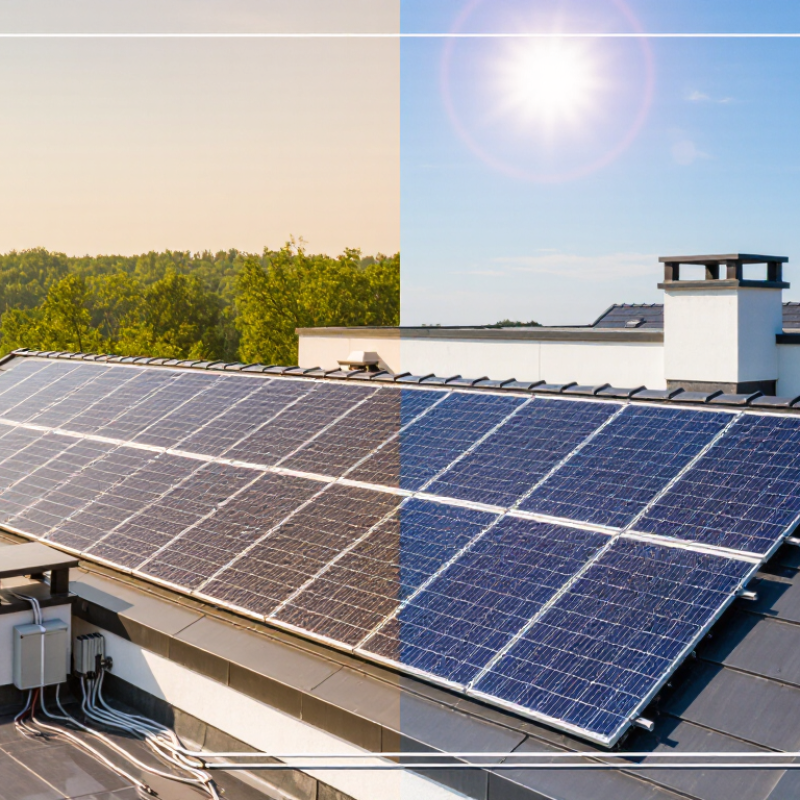
How to Choose Monocrystalline Solar Panels?

Define Monocrystalline Technology: 20–23% Efficiency and 25–30-Year Warranties

Monocrystalline solar panels use wafers cut from a single silicon crystal. This structure usually creates a uniform, dark appearance and strong power density. Fraunhofer ISE’s Photovoltaics Report shows that commercial crystalline-silicon modules commonly reach about 20–23% efficiency. Laboratory cells perform higher, but laboratory results should not guide a household purchase alone.

Efficiency matters when roof space is limited. A 22% panel can produce more electricity from the same area than an 18% panel under comparable conditions. However, temperature, shading, orientation, dust, and inverter losses also reduce real output. The IEA PVPS Trends report highlights continued improvements in module performance, yet field conditions remain less predictable than test laboratories. That difference matters.

Read the warranty language carefully. Many monocrystalline panels carry 25–30-year performance warranties, while product warranties may cover fewer years. A performance warranty often promises roughly 80–90% of the original output near the final year, depending on its terms. NREL degradation research commonly uses about 0.5% annual degradation as a planning reference, but actual results vary. Ask for the first-year degradation rate, annual rate, testing standard, and replacement process. Numbers can look reassuring. The small print decides their value. A higher efficiency panel may still be a poor choice if its warranty support, temperature behavior, or installation quality is weak.

Evaluate Roof Conditions Using Irradiance, Orientation, Tilt, and Shading Data

How to Choose Monocrystalline Solar Panels?

Roof conditions should guide the panel choice, not efficiency claims alone. Start with irradiance data from the Global Solar Atlas, developed with World Bank and ESMAP support. It uses long-term satellite and ground measurements to estimate solar resource by location. Compare the roof’s annual irradiation with nearby obstructions, not just a weather app’s daily forecast.

Orientation and tilt matter, but there is no universal perfect angle. In the Northern Hemisphere, a south-facing roof usually receives strong annual exposure. East- and west-facing roofs can still work, especially when household demand peaks in the morning or afternoon.

The International Energy Agency Photovoltaic Power Systems Programme notes that system design must consider local climate, roof geometry, and operating conditions. Monocrystalline panels may perform well on limited roof space, but their advantage disappears if placement ignores roof losses.

Shading needs hourly attention. A chimney shadow at 9 a.m. is different from tree cover across the afternoon. IEA PVPS Task 13 explains that partial shading can cause mismatch and bypass-diode losses beyond the shaded cell area.

NREL’s PVWatts guidance models these effects rather than applying one universal penalty. Use a shade analysis across seasons. Small errors remain possible.

A roof inspection in winter may miss summer tree growth, and I should not pretend a single irradiance reading proves annual performance. Record azimuth, tilt, obstruction height, and monthly shade duration before selecting the panel layout.

Match Panel Power, Voltage, and Current to the Inverter and System Size

How to Choose Monocrystalline Solar Panels?

Match panel power to the inverter and the system’s expected energy demand. IEA PVPS Trends 2024 reported approximately 456 GW of new solar capacity worldwide in 2023. This growth increases product choice, but higher wattage is not automatically better. A 450 W panel may reduce the number of modules, yet roof shape, shading, and inverter input limits still matter. Estimate daily consumption, then compare it with local sunlight and expected system losses.

Check voltage and current carefully. Panel voltage at maximum power, or Vmp, should operate inside the inverter’s MPPT range. The open-circuit voltage, Voc, must remain below the inverter’s maximum DC voltage during the coldest local morning. Temperature changes matter. Cold weather can raise Voc significantly. Panel operating current, Imp, and short-circuit current, Isc, must also stay within the inverter’s input limits. Parallel strings increase current. Series strings increase voltage.

Leave engineering margin. NREL’s photovoltaic system guidance emphasizes temperature, wiring, mismatch, and shading losses during performance evaluation. In practice, installers should calculate string values, not copy a neighbor’s design. A tidy layout can still be electrically unsuitable. I would also recheck the datasheet tolerance, because “maximum” ratings are not design targets. Some early estimates may be wrong. That is acceptable when measurements, weather data, and inverter limits are reviewed before installation.

How to Choose Monocrystalline Solar Panels?

Match panel power, voltage, and current to the inverter and system size

The chart compares representative monocrystalline panels from 400 W to 550 W. Panel voltage and current should remain within the inverter’s MPPT voltage range and maximum input current. For a system close to 5 kW DC, approximately 13 panels of 400 W, 12 panels of 450 W, 10 panels of 500 W, or 10 panels of 550 W may be used, subject to roof space, inverter limits, temperature conditions, and local design requirements.

Compare Temperature Coefficients Near −0.30%/°C and Annual Degradation Below 0.5%

How to Choose Monocrystalline Solar Panels?

A panel’s temperature coefficient matters when summer heat raises its cell temperature. A coefficient near −0.30%/°C is a useful benchmark. Lower negative values usually mean better hot-weather performance. At 65°C, the cells are 40°C above standard testing conditions. A −0.30%/°C coefficient could reduce power by about 12%. That difference becomes visible on a hot roof with limited airflow. I have seen panels produce less than expected when installers ignored rear ventilation.

Check the datasheet carefully. Confirm whether the coefficient describes power, voltage, or current. These figures are not interchangeable. Compare results under the same test conditions. Independent test reports and certification records can strengthen confidence. Still, a datasheet is not the whole roof. Dust, shade, cable losses, and mounting height also affect production.

Annual degradation below 0.5% deserves equal attention. At that rate, simple linear math suggests about 12.5% loss over 25 years. Real performance may differ. Early degradation can be uneven, and climate exposure changes the result. Look for testing evidence, warranty terms, and clear measurement methods. A panel with excellent laboratory numbers may disappoint under coastal humidity or repeated heat cycles. I would compare several models using local temperature data, not only their peak wattage. The choice is less perfect than it appears.

How to Choose Monocrystalline Solar Panels? - Compare Temperature Coefficients Near −0.30%/°C and Annual Degradation Below 0.5%

A practical, brand-neutral comparison guide for evaluating monocrystalline photovoltaic modules

Evaluation Dimension Recommended Target Typical Monocrystalline Range Preferred Benchmark Why It Matters
Power Temperature Coefficient −0.30%/°C or lower Approximately −0.29% to −0.40%/°C −0.30%/°C to −0.32%/°C A less negative coefficient reduces power loss during hot operating conditions. Compare the value for maximum power, not only the open-circuit voltage coefficient.
Annual Degradation After Year One Below 0.50% per year Approximately 0.25% to 0.50% per year 0.25% to 0.35% per year Lower degradation helps preserve energy yield over the system lifetime. Check whether the warranty specifies a first-year loss separately from the annual rate thereafter.
End-of-Year-25 Retained Power At least 85% of initial rated power About 84% to 90%, depending on the warranty model Approximately 87% to 90% This value is linked to the first-year degradation and subsequent annual degradation. It is useful for comparing long-term energy output.
Module Efficiency at STC 20% or higher Approximately 19% to 23% 21% to 23% Higher efficiency produces more power from a limited roof area. STC means 1,000 W/m² irradiance, 25°C cell temperature, and AM1.5 reference spectrum.
Rated Power per Module Select according to roof area and inverter design Approximately 350 W to 600 W for common full-size modules 450 W to 600 W for large-format modules Higher wattage does not automatically mean higher quality. Confirm module dimensions, structural load, transport requirements, and inverter compatibility.
Operating Temperature Range At least −40°C to +85°C Commonly −40°C to +85°C −40°C to +85°C or wider when documented The range indicates the environmental conditions covered by the product specification. Actual power output is still affected by irradiance, wind, mounting, and cell temperature.
Maximum System Voltage Compatible with the complete system design Typically 1,000 V or 1,500 V DC Matches the inverter, string length, and local electrical code The module voltage rating must not be considered independently from the inverter’s maximum DC voltage and the lowest expected ambient temperature.
Mechanical Load Rating Verify project-specific wind and snow loads Commonly around 2,400 Pa front load and 4,000 Pa rear load, subject to design Suitable for the site after engineering verification Load ratings depend on mounting configuration, rail spacing, clamps, frame design, and testing conditions. They should be checked against local building requirements.
Certification and Safety IEC 61215 and IEC 61730 certification Certification scope varies by market and product model Current certificates covering the exact module model IEC 61215 addresses design qualification and type approval, while IEC 61730 addresses photovoltaic module safety. Confirm certificates with the supplier or certification body.
Bifacial Capability Use when rear-side irradiance is available Available on many glass-glass or rear-transparent designs Documented rear-side power gain and compatible mounting conditions Bifacial gain depends on albedo, row spacing, mounting height, ground cover, and site geometry. It should not be treated as a fixed percentage for every installation.
Best Application Fit Match the panel to the site rather than choosing by wattage alone Residential roofs, commercial roofs, carports, and ground-mounted systems Low temperature coefficient and low degradation for hot climates or long project lifetimes Temperature behavior, degradation, shade conditions, available area, local climate, and installation quality collectively determine lifetime energy yield.

Interpretation: A power temperature coefficient closer to zero, such as −0.30%/°C, generally performs better in hot conditions than −0.40%/°C. For long-term value, prioritize an annual degradation rate below 0.50% after the first year and a clearly documented end-of-year-25 power guarantee.

Important: Temperature coefficients and degradation figures must be taken from the datasheet and warranty for the exact module model. Actual energy production also depends on orientation, tilt, shading, soiling, ventilation, inverter losses, and local weather.

Reference framework: Standard Test Conditions are commonly defined as 1,000 W/m² irradiance, 25°C cell temperature, and AM1.5 spectrum. IEC 61215 and IEC 61730 are widely used international reference standards for photovoltaic module qualification and safety.

Verify Certifications, Fire Ratings, Product Guarantees, and Lifecycle Costs

How to Choose Monocrystalline Solar Panels?

Certification checks should begin with the exact panel model, not a similar product photograph. Ask for current certificates, testing laboratory details, and the covered production site. A certificate number should match the manufacturer’s documentation and local electrical requirements. “Certified” is not enough. The scope matters. I would also check whether the certification remains valid for the intended installation environment, such as high humidity, salt air, or heavy snow.

Fire ratings need careful attention because the panel, roof, mounting system, and installation method may be tested together. A strong panel rating may not protect an unsuitable roof assembly. Request the full fire-test classification and installation conditions.

Product guarantees deserve the same scrutiny. Compare the warranty period, degradation limit, claim process, labor coverage, and exclusions. Read the fine print. Some guarantees appear generous but become difficult to use when documentation or authorized installation is required.

Lifecycle cost is more than the purchase price. Estimate expected energy production, annual degradation, cleaning access, monitoring, and possible replacement costs. A panel with a slightly higher price may produce more electricity after twenty years.

Check temperature behavior and performance in partial shade, especially near chimneys or nearby trees. I once focused too heavily on efficiency and underestimated roof-access costs. That was a useful mistake. A realistic comparison should include installation quality, local climate, financing charges, and disposal requirements.

Keep every certificate, invoice, and commissioning record. They may become important later.

FAQS

Is a higher-wattage solar panel always the better choice?

No. A 450-watt panel may reduce module count, but roof shape and shading still matter. More power is not automatically better.

How should panel power match the inverter?

Compare total panel power with the inverter’s input range and household energy demand. Include local sunlight and expected system losses.

Why are Vmp and Voc important?

Vmp must stay within the inverter’s MPPT operating range. Voc must remain below the maximum DC voltage during cold mornings.

How do temperature changes affect panel selection?

Cold weather can raise Voc significantly. Check the lowest local temperature before approving the series-string design.

What happens when panels are connected in series or parallel?

Series connections increase voltage. Parallel connections increase current. Both values must remain within inverter input limits.

What certifications should buyers verify?

Check the exact panel model, certificate number, testing laboratory, and production site. Confirm the certification suits humidity, salt air, or heavy snow.

Does a strong fire rating guarantee safe roof installation?

No. Fire performance may depend on the panel, roof, mounting system, and installation method together. Request the complete classification and conditions.

What should a product guarantee include?

Review its duration, degradation limit, claim process, labor coverage, and exclusions. A generous guarantee can still be difficult to use.

How should lifecycle cost be calculated?

Include purchase price, installation, cleaning access, monitoring, degradation, financing, replacement, and disposal. A cheaper panel may cost more later.

What records should be kept after installation?

Keep certificates, invoices, datasheets, and commissioning records. They may support future claims or troubleshooting. My early estimates could be wrong.

Conclusion

Choosing Monocrystalline solar panels requires more than comparing advertised wattage. Their single-crystal structure typically delivers efficiency around 20–23% and is commonly supported by 25–30-year warranties, making them suitable where roof space is limited. Before selecting a model, assess the roof’s solar irradiance, orientation, tilt, usable area, and shading throughout the day. These factors determine how much energy the system can realistically produce.

The panel’s power, operating voltage, and current should match the inverter and overall system design to promote safe, stable performance. Also compare temperature coefficients, ideally near −0.30%/°C, because output can decline as temperatures rise, and review annual degradation rates below 0.5% for stronger long-term value. Finally, verify relevant certifications, fire ratings, product guarantees, installation requirements, and lifecycle costs, including maintenance, replacement, and expected energy savings. A balanced evaluation of performance, reliability, compatibility, and total ownership cost will support a more practical solar investment.

Oliver

Oliver

Oliver is a professional marketing specialist dedicated to helping businesses understand products, discover practical solutions, and make confident decisions. With extensive knowledge of the company’s offerings, he combines market insight, clear communication, and a customer-focused approach to......